


How to Start a Landscaping Business in College at 18 (and Pay for Your Degree)
I didn’t plan to start a landscaping business in college — it just kind of happened. The summer after I graduated high school, I quit my dishwashing job. The pay was bad, the hours were worse, and I figured I’d take the summer off to relax before heading to university.
But my mom had other plans. Without telling me, she posted on Nextdoor — a neighborhood app where people hire help, post odd jobs, and overshare about their pets — saying her 18-year-old son was looking for work to save up for school.
The first reply came fast: $20 an hour, cash, for a landscaping job. That felt like hitting the jackpot. It paid better, was outside, and gave me more freedom than anything I’d done before. By the end of the summer, I was fully booked and making more money than I thought possible — all while building something that would pay my tuition, fund my travels, and teach me lessons I still use today.
Here’s exactly how it happened, what I learned, how much I earned, and what I’d do differently if I had to do it all over again.
Why I Chose Landscaping and How it Started
When that first message came through on Nextdoor — $20 an hour, cash — I honestly thought it might be a scam. But it wasn’t. A neighbor a few blocks away needed help clearing some overgrown garden beds and trimming hedges.
I showed up the next day, and to my surprise, he already had all the tools I needed: hedge trimmers, a mower, gloves, everything. All I had to do was show up and work. It was straightforward but tiring — by the time I finished, I was sweaty, sunburned, and already thinking about how good it felt to walk away with a fistful of cash for just a few hours of work.
For the next few jobs, I started bringing whatever tools we had lying around at home — nothing fancy, but good enough to get the job done. I kept it simple, worked just three or four hours a day, and still had plenty of time to enjoy my summer.
What surprised me most wasn’t just the pay — though at $20 an hour, it already beat my old dishwashing job by a mile — but how quickly more work came in. That first client left a glowing comment on my mom’s Nextdoor post, which bumped it back to the top of the feed and brought in more eyes.

Then someone else messaged. Then another. Within a week, I was booked almost every day. At the time, I didn’t really think of it as a “business” — it just felt like a side hustle that kept me busy and paid better than anything else I could have been doing.
By the end of the summer, I headed off to college with far more money than I’d expected, feeling optimistic about the future and already starting to think about what other opportunities might be out there.
Pro Tip: Use platforms like Nextdoor, Facebook Marketplace, and local bulletin boards to find your first clients. Write a short, clear post about what you offer and how it helps them.
What Everyone’s Really Asking: How Much Did You Make?
What Everyone’s Really Asking: How Much Did You Make?
The big question everyone wants to know is: How much money did I actually make running a landscaping business in college?
Over the years, this side hustle turned business earned me well over $100,000 — money that paid tuition, rent, investments, and even funded two years living abroad without working.
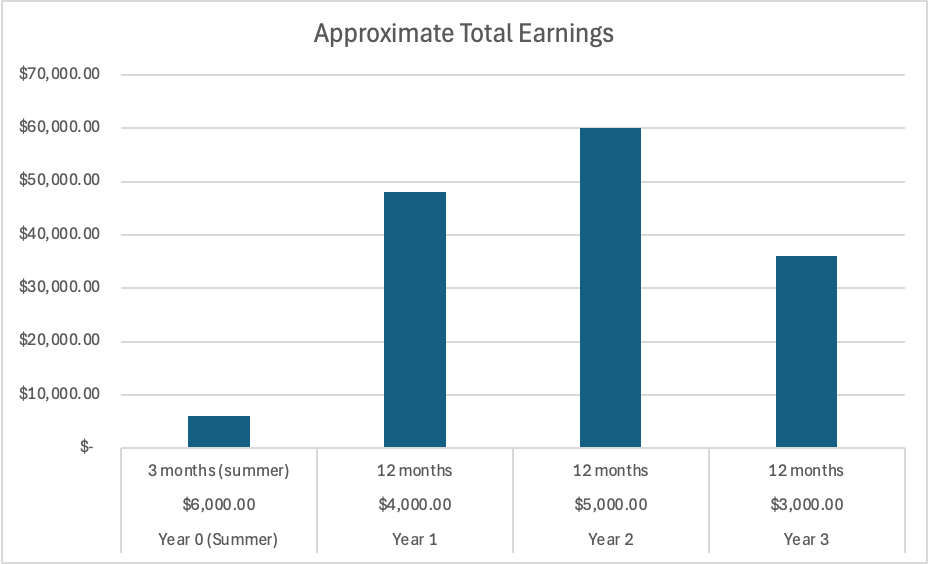
Here’s a breakdown of how my monthly profits grew, peaked, and eventually slowed down as I prepared for graduation and life after college.
Pro Tip: Track every dollar you earn and spend. Starting with lower rates is fine, but raise them as your reputation grows.
Monthly Revenue by Year (USD)
| Year | Monthly Profit Estimate | Notes |
|---|---|---|
| Year 0 (Summer) | ~$6,000 total* | First summer, side hustle, 3-4 hrs/day |
| Year 1 | ~$4,000 | Officially made it a business |
| Year 2 | $4,000 – $6,000 | Growth, marketing, hiring help |
| Year 3 | ~$3,000 | Slowing down, prepping for graduation |
*Note: Year 0 is total for the summer months, not monthly.
What I Learned About Business as an 18 Year Old
People often say, “Be your own boss and you’ll have total freedom.” But as I quickly learned, you’re still working for someone — your clients. (This idea is well summarized by Paul Graham)
That perspective shaped how I approached my landscaping business — and taught me more than I ever expected.
One of the biggest lessons was about pricing. My first summer, I charged $20 an hour. When I came back after university, I officially incorporated, upgraded my equipment, and hired a few friends. I realized I could charge per-worker, or better yet, per-job — and my earning potential went way up. If I didn’t really want a job, I’d price it high — and people still paid. That was a turning point: learning that what you think is expensive isn’t necessarily expensive to someone else.

Pro Tip: Don’t just charge by the hour. Price per job when you can, and don’t be afraid to quote high if it’s a tough or undesirable job — you might be surprised who says yes.
Working with clients was another eye-opener. Communication was everything. Many of my clients were older and liked to chat, so I gave them the space and engaged. I shared my story about working toward a degree, and they respected my ambition. But I also learned you can’t please everyone. You’re the boss — and that means you get to say no when a client isn’t worth the headache.
Pro Tip: Relate to your clients as humans, but don’t be a pushover. You’re allowed to turn down bad jobs or difficult customers.
Managing my time was a challenge too. One year, I worked 10-hour days constantly. I didn’t mind the grind, but it left no room for a social life. I learned to protect weekends, take vacations, and treat the summer as a sprint — knowing the winters were slower.
Pro Tip: Build recovery time into your schedule. A tired, burned-out boss is just as bad as a tired employee.
When it came to hiring & managing friends, that was tricky. Being the boss meant I called the shots — but I also took the risk. Some jobs I mispriced and my workers made more than I did. Some friends turned out to be terrible workers, and I had to face the awkward reality of separating friendships from employment. I even clashed with my brother, who thought my earnings were unfair compared to his.
Pro Tip: If you hire friends or family, set clear expectations up front — and don’t be afraid to enforce them.
Running the business surprised me in other ways too. It pushed me out of my comfort zone — knocking on doors, selling myself, dealing with all kinds of people. It also taught me how to spot tax advantages: since I was studying business while running a business, I could write off part of my education as a business expense — which kept my profit margins healthy.
Pro Tip: Learn the basics of small business taxes early. Even simple strategies can save you thousands.
Above all, it taught me that I really could do whatever I put my mind to — as long as I was willing to show up, learn from mistakes, and keep improving.
What Set Me Apart From the Competition
If you’ve ever hired someone to mow your lawn, you already know the bar in this industry is low. People don’t show up. They don’t return calls. They cut corners. They disappear.
So what set me apart? Honestly — it was the simple stuff.
Clients trusted me because they saw a young, ambitious kid working hard to pay for college. I responded to messages quickly. I showed up on time. I did what I promised. That alone put me miles ahead of a lot of other people. Many of my clients even had kids my age, so they related to me and respected the bigger goals I was working toward.
Pro Tip: In the service industry, reliability is a competitive advantage. Show up. Follow up. Do the work you promised. You’ll instantly stand out.
I also used battery-powered, eco-friendly equipment — which at the time was still a novelty. Not everyone cared about that, but a few clients really appreciated it, and that was enough. It was less noisy, better for the environment, and made me memorable — even if it wasn’t always the most convenient for me.

The way I communicated also made a huge difference. I answered calls and texts quickly, gave clear quotes, and kept clients updated. It sounds obvious, but so many people don’t bother.
| Pro Tip: Communicate better than your competitors. People pay more for peace of mind than for perfection.
Of course, my age worked against me sometimes — especially on bigger jobs. Some clients doubted my abilities, and I lost a few contracts because of it. Looking back, I don’t blame them. Everything I knew I’d learned on the job and I made a lot of mistakes. But in the end, the trust I built and the relationships I formed outweighed the downsides of being young
Challenges & Mistakes
Running a landscaping business while in school wasn’t all sunshine and cash. There were plenty of challenges — and more than a few mistakes.
The biggest challenge was scaling. Getting the business from one level to the next required serious capital — investments I wasn’t ready to make, since I was never fully bought in. I was always torn: should I drop out of university and go all-in? Should I get into real estate? In the end, I stuck with school, but part of me still wonders what would’ve happened if I’d gone for it.
Pro Tip: If you want to grow beyond a one-person business, be prepared to reinvest your profits — and decide early if you’re really willing to commit.
I also agreed to jobs that were way over my head. These didn’t go well for anyone. I didn’t take payment because they weren’t completed properly, which wasted everyone’s time and hurt my reputation. If a job feels way beyond your ability, politely decline or subcontract someone with the right expertise.
There were also tough lessons about trust. One client hired me for a large job worth a few thousand dollars. After completing it, she gave me partial payment and asked me to do another job. When both were done, she claimed she couldn’t pay the balance. I let her pay in small installments for a while, but eventually she stopped altogether — and I never got the rest.
Pro Tip: Always use clear, written agreements for bigger jobs — and don’t start work until you’ve agreed on terms and a payment schedule.
And if I could go back? I’d invest more into the business, grow it into something that could run without me, and set it up to sell when I was ready to leave. Instead, when I moved to Spain, I had already mentally checked out — and the business was a mess. That’s something I’d definitely do differently.

How It Paid Off
Looking back, what I’m most proud of isn’t just the money — it’s how far I took it from where it started. What began as a random post my mom put on Nextdoor turned into a business that completely changed my life. Yes, there was luck involved, but I also worked my ass off — and I think a lot of people in my position would’ve stopped after that first client.
Pro Tip: Everyone gets opportunities — but very few people actually follow through long enough to see what’s possible.
The financial payoff was huge. I paid for my entire university degree without taking on debt. I invested in stocks, made some wild returns during the NFT boom, and funded two years of living in Spain — where I studied Spanish full-time and traveled every chance I got.
But even more than the money, what I gained was confidence. I proved to myself that I could build something from nothing, graduate debt-free, and finance the kind of life I wanted to live. That’s an amazing feeling — and it’s given me the certainty that I’ll have success in whatever I choose to do next.

I also learned that while I loved being my own boss, I didn’t necessarily want to stay in a service-based business forever. Running a business taught me how to spot opportunities, how to work with people, and how to see that my options are unlimited — and that realization is priceless. Sometimes the biggest payoff from starting a business isn’t just the money — it’s the confidence and perspective you gain along the way.
What I’m Doing Now & Final Thoughts
These days, I’m living abroad in Vienna with my amazing girlfriend, traveling constantly, and looking for the next big opportunity. I’m working on building this website and sharing what I’ve learned along the way.

If you’re curious, check out a few of my recent trips:
– Camino de Santiago: 3-Day Itinerary
– Why I Won’t Be Returning to Cairo
– My 11-Day Morocco Road Trip Itinerary
Pro Tip: Don’t wait for the perfect time. Start now — learn as you go.
As for landscaping? That chapter is closed. I have no plans to go back to service-based work. Digital business is where I want to be, and everything I learned from running my landscaping business is helping me make that possible now.
If you’re thinking about starting your own business while in school, here’s my advice: just go for it. What do you really have to lose? The initial investment is a few hundred dollars at most. Save it, invest it, market yourself, and watch the money come in.
FAQ: Starting a Landscaping Business in College
How much can you make running a landscaping business in college?
It depends how much you want to work and how smart you are about pricing. In my best years, I was making between $4,000–$6,000 a month during the summer, and even my first summer brought in about $6,000 total. Over the full run, I earned well over $100,000.
How do you find clients as a student landscaper?
My first client came from a post my mom made on Nextdoor, and from there it snowballed through word of mouth. You can also use Facebook Marketplace, flyers in your neighborhood, and referrals. The key is just getting your name out there and responding quickly. Just go knock on the doors of every house in your neighborhood and you’ll get some work.
What equipment do you need to start landscaping?
Not much to begin with — I borrowed tools from my parents at first. A mower, trimmer, and basic hand tools are plenty to get started. You can upgrade later as you reinvest your earnings.
Do you need to register your business or pay taxes?
Yes. Once you’re making real money, you should definitely register your business and start tracking income and expenses. In my case, I incorporated after my first summer. I also learned about small-business tax advantages — which saved me thousands.
How much should you charge for landscaping work?
I started at $20/hour and eventually charged at least $40/hour, often bidding jobs by the project rather than by the hour. Don’t undervalue your time — price based on difficulty, demand, and your level of service.
Is running a landscaping business as a student worth it?
Absolutely — if you’re willing to work. I graduated debt-free, invested in stocks, funded two years living abroad, and learned skills I still use today. But it’s also physically demanding and takes discipline.
Can you start a landscaping business with no experience?
Yes — I did. I learned everything on the job, asked questions, and improved with each client. People care more about your attitude and reliability than your technical expertise in the beginning.
How many hours a week do student landscapers usually work?
It depends on your schedule. In my busiest summers, I worked 30–50 hours a week, but you can also keep it part-time if you want balance. You set your own limits.
What are the biggest challenges of running a landscaping business?
Scaling is hard, especially if you’re not ready to reinvest. Clients can be picky or unreliable. And it’s physically demanding — especially in the heat.
Do you need a license or permit to start landscaping?
Check your local laws. In most places, you don’t need a license for basic mowing and maintenance, but you might if you offer chemical treatments or bigger projects. It’s always best to check with your city or county.
How do you stand out from other landscapers?
Do the simple things right: show up, communicate, follow through, and care about your clients. Adding little differentiators — like eco-friendly tools or being personable — also helps set you apart.
